

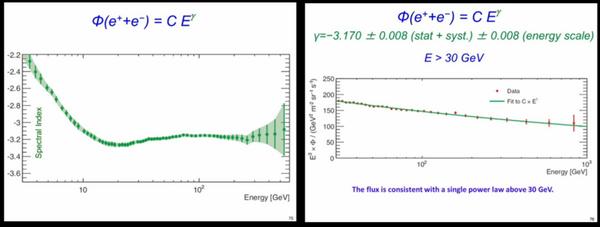
The newest data from the Alpha Magnetic Spectrometer are fully compatible with the positron flux curve resulting from an annihilating lighter than \(1\TeV\) dark matter particle. But the steep drop itself hasn't been seen yet (the AMS' dark matter discovery is one seminar away but it may always be so in the future LOL) and the power-law description seems really accurate and attractive.
What if neither dirty pulsars nor dark matter is the cause of these curves? All of those who claim to love simple explanations and who sometimes feel annoyed that physics has gotten too complicated are invited to think about the question.
The fact at this moment seems to be that above the energy \(30\GeV\) and perhaps up to \(430\GeV\) or much higher, the positrons represent \(0.15\) of the total electron+positron flux. Moreover, this flux itself depends on the energy via a simple power law:\[
\Phi(e^- + e^+) = C \cdot E^\gamma
\] where the exponent \(\gamma\) has a pretty well-defined value.
Apparently, things work very well in that rather long interval if the exponent (spectral index) is\[
\gamma= -3.170 \pm 0.008 \pm 0.008
\] The first part of the error unifies the systematic and statistical error; the other one is from the energy scale errors. At any rate, the exponent is literally between \(-3.18\) and \(-3.16\), quite some lunch for numerologists.
My question for the numerologist and simple ingenious armchair physicist (and others!) reading this blog is: what in the Universe may produce such a power law for the positron and electron flux, with this bizarre negative exponent?
The thermal radiation is no good if the temperature \(kT\) is below those \(30\GeV\): you would get an exponential decrease. You may think about the thermal radiation in some decoupled component of the Universe whose temperature is huge, above \(430\GeV\), but then you will get something like \(\gamma=0\) or a nearby integer instead of the strange, large, and fractional negative constant.
You may continue by thinking about some sources distributed according to this power law, for example microscopic (but I mean much heavier than the Planck mass!) black holes. Such Hawking-radiating black holes might emit as many positrons as electrons so it doesn't look great but ignore this problem – there may be selective conversion to electrons because of some extra dirty effects, or enhanced annihilation of positrons.
If you want the Hawking radiation to have energy between \(30\) and \(430\GeV\), what is the radius and size of the black hole? How many black holes like that do you need to get the right power law? What will be their mass density needed to obtain the observed flux? Is this mass density compatible with the basic data about the energy density that we know?
Now, if that theory can pass all your tests, you also need the number of smaller i.e. lighter i.e. hotter microscopic black holes (those emitting higher-energy radiation) to be larger. Can you explain why the small black holes should dominate in this way? May the exponent \(-3.17\) appear in this way? Can you get this dominance of smaller black holes in the process of their gradual merger? Or thanks to the reduction of their sizes during evaporation?
I am looking forward to your solutions – with numbers and somewhat solid arguments. You can do it! ;-)
A completely different explanation: the high-energy electrons and positrons could arise from some form of "multiple decoupling events" in the very high-energy sector of the world that isn't in thermal equilibrium with everything else. Can you propose a convincing model about the moments of decoupling and the corresponding temperature that would produce such high-energy particles?







0 Comments